
A soft decline is a decline that the issuer indicates may succeed on retry under different conditions — typically when a step-up authentication is needed or a temporary issue prevented approval. It contrasts with a hard decline, which signals the payment cannot succeed in its current form and retrying is wasteful. Treating soft and hard declines the same way is one of the most common acceptance leaks.
Travel payments glossary
Soft decline
A decline that may succeed on retry under different conditions.
Why it matters in travel
In travel, soft declines on deposits are commonly recoverable through Strong Customer Authentication or a quick retry with the right exemption flag, while hard declines need a different card or method. Distinguishing the two recovers real revenue.
The lost-deposit pattern is real and material. A travel customer who soft-declines once and is not retried correctly will often book elsewhere within the hour. Multiply that by the soft-decline rate across an issuer-country mix and the unattended revenue loss can be more than the percentage points of MDR the same business is fighting to negotiate down.
The teams that recover soft declines well treat them like a queue, not an error. The retry strategy is tuned by issuer, by card product and by booking value — and the customer experience is invisible because the retry happens before they have time to navigate away. The teams that treat every decline as final lose recoverable bookings every day and rarely measure it.
How felloh helps
felloh classifies decline codes and surfaces the right next step against the booking so soft declines are recovered and hard declines do not waste retry budget.
The Transactions and Decline Analysis views in the dashboard classify declines by code and outcome, with soft declines routed to SCA-step-up or quick retry while hard declines surface to the customer with the right prompt. Playbooks automate the recovery flow against specific decline patterns.
For travel businesses where deposit-moment declines used to lose real revenue, the recovery pipeline runs without manual intervention. Soft-decline conversion improves, hard-decline waste drops, and the resulting bookings show up against the original attempt so the value is measurable.
Where this shows up in risk and disputes.
Soft decline touches more than one workflow at felloh. Start with the pages most travel teams reach for next.
- Financial Control
Control refunds, exceptions, supplier exposure and payment risk against the same booking record.
Explore - Financial Protection Data
Authentication, settlement, protected funds and refund history kept with the booking for dispute defence.
Explore - Payment Optimisation
Acceptance, decline and authentication evidence so you can act on the patterns that matter.
Explore
More on payment risk and disputes.
Real-world context from the felloh team and customers, written for travel finance and operations.
 Updates
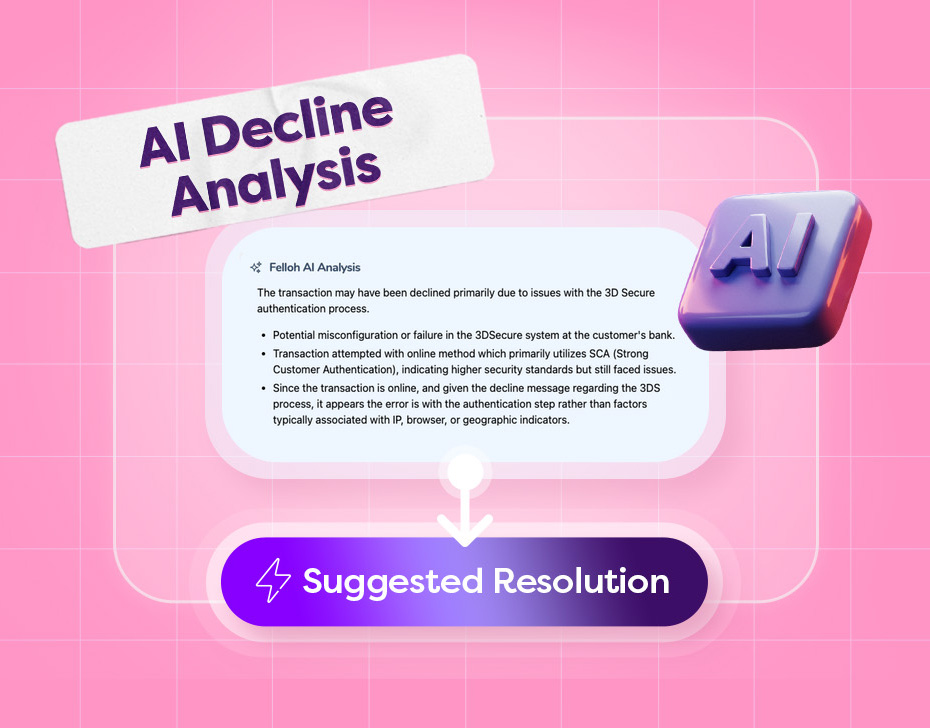
Enhance Your Payment Success with felloh's AI Decline Analysis for the Travel Industry
felloh's AI Decline Analysis surfaces real-time insight on why card payments fail and the best next step — for higher acceptance on travel bookings.
Read article Insights
Minimising Payment Risks of phone payments: The Smart Way for Travel Merchants
Phone bookings are still essential in travel, but they carry payment-security risk. How to keep last-minute trips moving without exposing the business.
Read article
Connect the dots.
See how payments, settlement, refunds and reporting evidence connect around every booking.