
Strong Customer Authentication, or SCA, is the PSD2 requirement that many electronic payments in the UK and EU must be authenticated using at least two of three factor categories — something the payer knows, something they have and something they are. It is delivered in practice through 3D Secure for cards, through biometric checks in banking apps for open-banking flows, and through equivalent flows for other methods. Specific exemptions reduce friction on low-risk and low-value transactions.
Travel payments glossary
Strong Customer Authentication
A regulatory authentication requirement for many electronic payments under PSD2.
Why it matters in travel
SCA can reduce fraud and shift chargeback liability, but it needs to be implemented in a way that does not break high-value bookings mid-checkout or create manual payment follow-up. The right balance is exemptions where appropriate and authentication where it adds protection.
For a UK or EU travel business, SCA is not optional but the shape of the implementation is. A blunt authentication policy that challenges every transaction breaks conversion on legitimate customers; a permissive one that exempts everything wastes the chargeback-liability shift the regulation was designed to give. The right balance is data-driven and tuned by booking value and issuer.
SCA also defines the difference between an authentication experience customers tolerate and one they abandon. A clean flow where the customer gets a single biometric prompt inside their banking app and is back to checkout in seconds is invisible. A flow where the customer is redirected three times, told to enter a static password, then asked to confirm by SMS is one many customers do not finish.
How felloh helps
felloh handles SCA, 3D Secure and exemption logic inside the booking-level picture so travel businesses can meet the requirement without breaking customer flow or losing evidence.
The pay checkout handles SCA flows with the right exemption claims by booking value, region and recurrence, and the dashboard’s Transactions view records the outcome — challenged, frictionless, exempted — against the booking. Risk Analysis surfaces SCA outcomes alongside chargeback patterns so exemption policy can be tuned by issuer.
For UK and EU travel businesses, SCA stops being a friction point in the funnel and becomes a measured part of the conversion picture. Authentication evidence flows through to dispute defence automatically, and exemption strategy lifts acceptance where the data supports it.
Where this shows up in risk and disputes.
Strong Customer Authentication touches more than one workflow at felloh. Start with the pages most travel teams reach for next.
- Financial Control
Control refunds, exceptions, supplier exposure and payment risk against the same booking record.
Explore - Financial Protection Data
Authentication, settlement, protected funds and refund history kept with the booking for dispute defence.
Explore - Payment Optimisation
Acceptance, decline and authentication evidence so you can act on the patterns that matter.
Explore
More on payment risk and disputes.
Real-world context from the felloh team and customers, written for travel finance and operations.
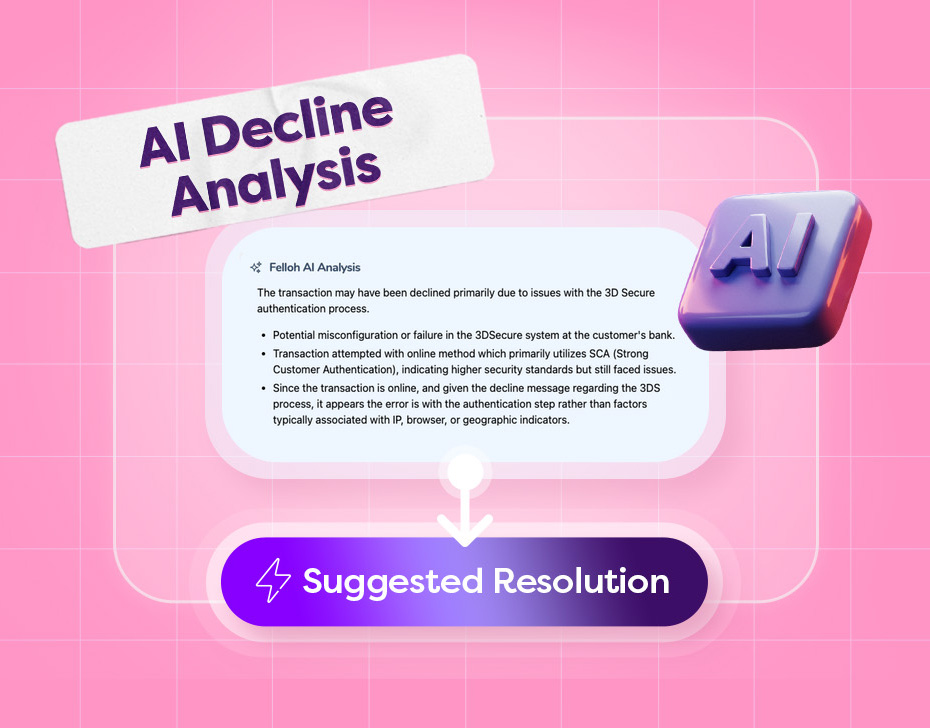 Updates
Enhance Your Payment Success with felloh's AI Decline Analysis for the Travel Industry
felloh's AI Decline Analysis surfaces real-time insight on why card payments fail and the best next step — for higher acceptance on travel bookings.
Read article Insights
Minimising Payment Risks of phone payments: The Smart Way for Travel Merchants
Phone bookings are still essential in travel, but they carry payment-security risk. How to keep last-minute trips moving without exposing the business.
Read article
Connect the dots.
See how payments, settlement, refunds and reporting evidence connect around every booking.