
3DS2 is the second version of the 3D Secure protocol used by Visa, Mastercard and other card schemes to authenticate online card payments before they are approved. It replaces the older redirect-heavy 3DS1 flow with a richer data exchange between merchant, acquirer and issuer, so that low-risk payments can pass through silently and only higher-risk ones trigger a step-up challenge such as a biometric prompt in the cardholder’s banking app. It is the technical backbone behind Strong Customer Authentication under PSD2 in the UK and Europe.
Travel payments glossary
3DS2 / 3D Secure 2
Card authentication that asks the cardholder to prove the payment is genuine.
Why it matters in travel
Travel bookings are often high value and made across phone, web, agent screens and email links, so authentication needs to work without breaking the customer journey. A failed challenge mid-booking can lose a deposit, push the balance into manual chase work and create disputed-payment risk against a non-refundable supplier commitment. Done well, 3DS2 shifts chargeback liability away from the travel business while keeping cards behind authentication evidence the finance team can rely on at month end.
3DS2’s real win over 3DS1 is invisibility on low-risk transactions. A repeat customer paying a balance against a known booking should not have to authenticate at all — the data exchange behind the scenes can tell the issuer the transaction is safe, and the customer experiences a single click instead of an SMS code. That invisibility is what makes 3DS2 work for travel rather than against it.
The cost of 3DS2 done badly is conversion. A challenge presented as a redirect to an outdated branded form mid-booking will lose customers; the same challenge presented as a biometric prompt inside the customer’s banking app rarely does. Travel businesses that treat the authentication journey as part of the product experience capture more bookings than those that treat it as a compliance bolt-on.
How felloh helps
felloh keeps authentication, payment status and booking evidence connected, so finance and operations can see in one place whether a payment was authenticated, captured and matched to the right booking. When a challenge fails or a soft decline lands, the booking ledger surfaces it as an actionable exception rather than letting it disappear into an inbox.
In the felloh dashboard, the Transactions view records the 3DS outcome alongside the booking — authentication method, liability-shift status and the issuer that ultimately approved or challenged the payment. Decline Analysis groups failed authentications by issuer so you can see whether a particular bank is rejecting more than its share, and Risk Analysis rolls the picture up to portfolio level when chargebacks land.
The practical outcome is that the evidence to invoke a liability shift is already attached to the booking when a chargeback arrives. Representment becomes a query rather than an investigation, and the same authentication trail is available to customer support when a customer asks why their payment was challenged.
Where this shows up in risk and disputes.
3DS2 / 3D Secure 2 touches more than one workflow at felloh. Start with the pages most travel teams reach for next.
- Financial Control
Control refunds, exceptions, supplier exposure and payment risk against the same booking record.
Explore - Financial Protection Data
Authentication, settlement, protected funds and refund history kept with the booking for dispute defence.
Explore - Payment Optimisation
Acceptance, decline and authentication evidence so you can act on the patterns that matter.
Explore
More on payment risk and disputes.
Real-world context from the felloh team and customers, written for travel finance and operations.
 Updates
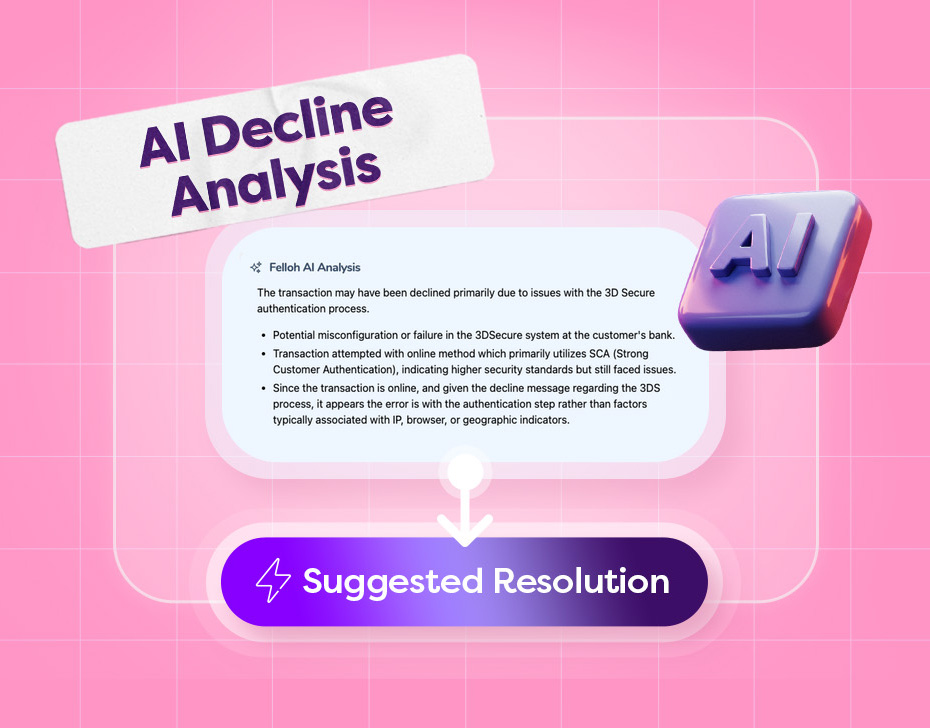
Enhance Your Payment Success with felloh's AI Decline Analysis for the Travel Industry
felloh's AI Decline Analysis surfaces real-time insight on why card payments fail and the best next step — for higher acceptance on travel bookings.
Read article Insights
Minimising Payment Risks of phone payments: The Smart Way for Travel Merchants
Phone bookings are still essential in travel, but they carry payment-security risk. How to keep last-minute trips moving without exposing the business.
Read article
Connect the dots.
See how payments, settlement, refunds and reporting evidence connect around every booking.