
A decline code is the scheme-defined code returned by an issuer when it refuses to authorise a payment, paired with a description such as “Insufficient funds”, “Do not honour” or “Card expired”. Decline codes are grouped into hard declines (where retrying will not help) and soft declines (where retrying or a different method might succeed). Understanding the code is what makes the difference between a useful retry and a wasted authorisation attempt.
Travel payments glossary
Decline code
The scheme code an issuer returns when it refuses to authorise a payment.
Why it matters in travel
A decline at the deposit moment can mean the booking is lost, but it can also mean a soft issuer block on an unusual transaction. Knowing the code tells the agent or system whether to ask the customer for a different card, to retry, to use SCA, or to flag the booking for follow-up.
Reading decline codes properly is the difference between recovering a booking and losing it. A "Do not honour" needs a customer-side intervention; a "Card expired" needs a different card; an issuer authentication failure needs a step-up flow. Treating every decline the same way costs revenue without saving any operational effort.
The travel businesses that recover declines well classify them by code and outcome, retry strategically and surface unrecoverable ones for human review. The businesses that do not classify them treat every decline as final and quietly lose bookings that a small retry would have saved.
How felloh helps
felloh translates decline codes into actionable booking-level state and surfaces the right next step, so failed payments become recoverable bookings rather than dropped revenue.
The Transactions view records the decline code against every failed attempt, and the Decline Analysis page rolls them up by reason, issuer and BIN so retry strategies can be tuned by signal rather than by guess. Playbooks can automate retry flows or customer-recovery emails against specific decline patterns.
For travel businesses where deposit-moment declines lose real revenue, the recovery pipeline becomes measurable. Soft declines that can be retried with SCA get retried automatically, hard declines that need a different card get the right customer prompt, and the resulting recovered bookings are visible against the original attempt.
Where this shows up in risk and disputes.
Decline code touches more than one workflow at felloh. Start with the pages most travel teams reach for next.
- Financial Control
Control refunds, exceptions, supplier exposure and payment risk against the same booking record.
Explore - Financial Protection Data
Authentication, settlement, protected funds and refund history kept with the booking for dispute defence.
Explore - Payment Optimisation
Acceptance, decline and authentication evidence so you can act on the patterns that matter.
Explore
More on payment risk and disputes.
Real-world context from the felloh team and customers, written for travel finance and operations.
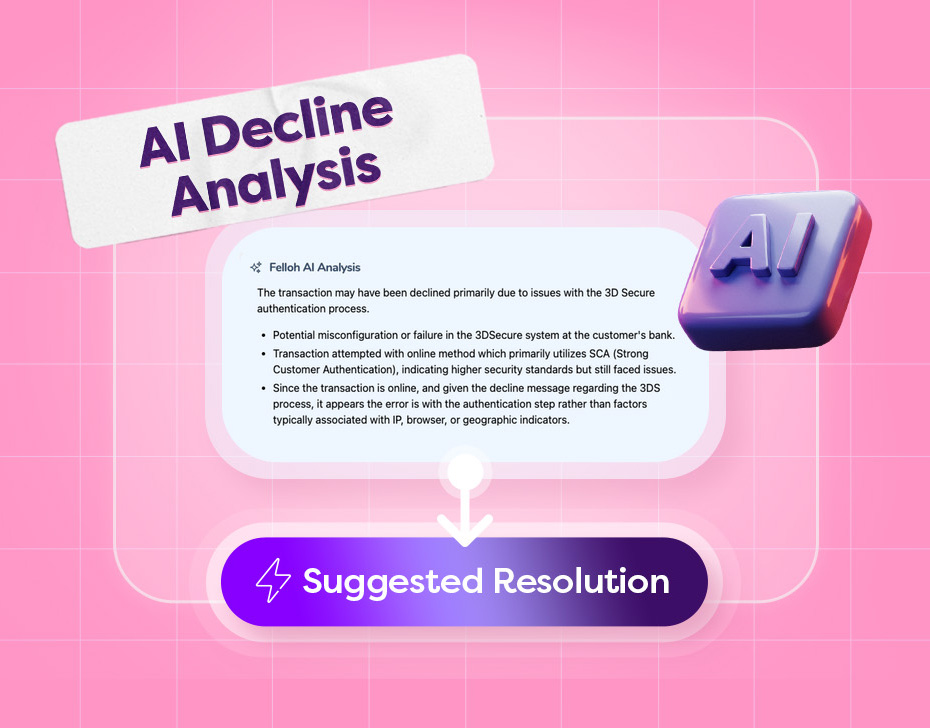 Updates
Enhance Your Payment Success with felloh's AI Decline Analysis for the Travel Industry
felloh's AI Decline Analysis surfaces real-time insight on why card payments fail and the best next step — for higher acceptance on travel bookings.
Read article Insights
Minimising Payment Risks of phone payments: The Smart Way for Travel Merchants
Phone bookings are still essential in travel, but they carry payment-security risk. How to keep last-minute trips moving without exposing the business.
Read article
Connect the dots.
See how payments, settlement, refunds and reporting evidence connect around every booking.