
A Card Verification Code (CVC), also called CVV, CV2 or CID depending on the scheme, is the short security code printed on a payment card — three digits on Visa and Mastercard, four on American Express. It is not stored on the magnetic stripe or chip and is intended to demonstrate that the cardholder has physical possession of the card during a card-not-present transaction. Merchants are not allowed to store CVC values under PCI DSS.
Travel payments glossary
CVC (Card Verification Code)
A short security code printed on a card that is checked during card-not-present payments.
Why it matters in travel
In travel, CVC is the front-line check during phone bookings, agent payments and online checkouts where the card is not physically present. A clean CVC match is one of the strongest non-authentication signals that the payer has the card in hand, which matters when committing against a non-refundable supplier booking.
Storing CVC values would be a fast route to a PCI DSS failure, so the rule is simple: collect it, send it for authorisation, never write it down. That single discipline drives a lot of operational design — agent screens that mask the field, call recordings that pause during entry, training that drills the point until it becomes muscle memory.
A CVC mismatch on a high-value travel booking is not just a decline; it is a signal worth investigating. It can mean a fat-fingered customer, a card recently reissued, or it can mean a card being tested against a stolen number. The teams that pay attention to CVC outcomes catch fraud waves earlier and avoid the chargebacks that would have landed weeks later.
How felloh helps
felloh records CVC, AVS and authentication results alongside the booking trail so risk and finance teams can see the verification picture against every payment without holding any of the values themselves.
The Transactions view exposes CVC results against the booking; the pay checkout collects CVC behind tokenised flows so the value itself never enters the operator’s PCI scope. Risk Analysis surfaces patterns — repeated CVC mismatches against a single BIN range, for example — as fraud signals to investigate.
For travel businesses worried about PCI scope and fraud at the same time, the result is that CVC is captured as evidence and discarded as data. The fraud signal is preserved, the PCI scope stays minimal, and the customer journey is unaffected.
Where this shows up in risk and disputes.
CVC (Card Verification Code) touches more than one workflow at felloh. Start with the pages most travel teams reach for next.
- Financial Control
Control refunds, exceptions, supplier exposure and payment risk against the same booking record.
Explore - Financial Protection Data
Authentication, settlement, protected funds and refund history kept with the booking for dispute defence.
Explore - Payment Optimisation
Acceptance, decline and authentication evidence so you can act on the patterns that matter.
Explore
More on payment risk and disputes.
Real-world context from the felloh team and customers, written for travel finance and operations.
 Updates
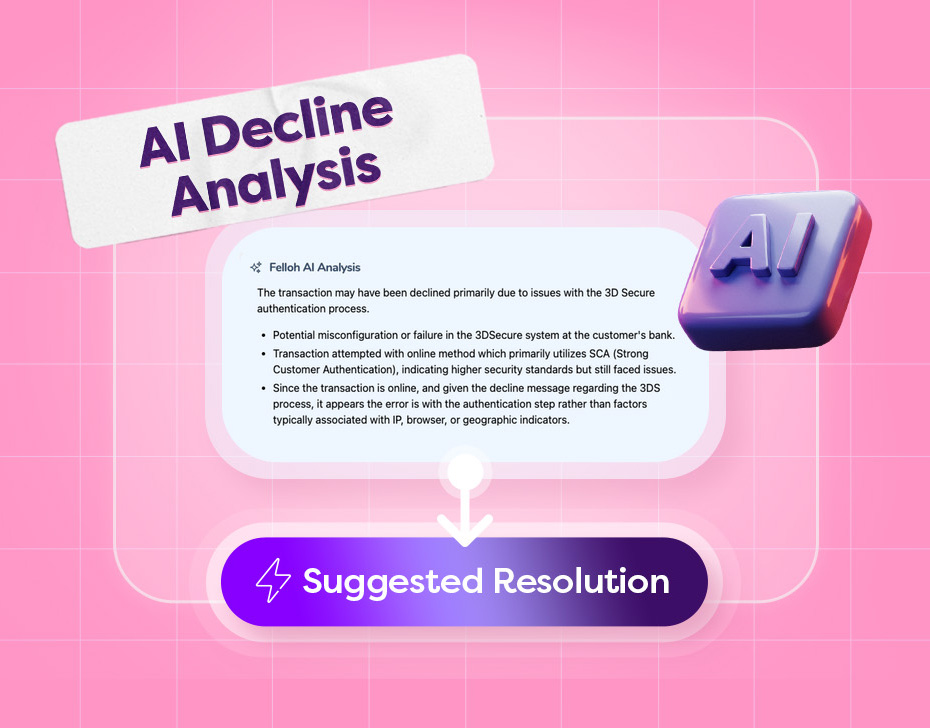
Enhance Your Payment Success with felloh's AI Decline Analysis for the Travel Industry
felloh's AI Decline Analysis surfaces real-time insight on why card payments fail and the best next step — for higher acceptance on travel bookings.
Read article Insights
Minimising Payment Risks of phone payments: The Smart Way for Travel Merchants
Phone bookings are still essential in travel, but they carry payment-security risk. How to keep last-minute trips moving without exposing the business.
Read article
Connect the dots.
See how payments, settlement, refunds and reporting evidence connect around every booking.