
The Address Verification System is a fraud-prevention check used during card authorisation that compares the numeric parts of the billing address (and postcode) provided by the merchant against the address the issuer holds on file. The issuer returns an AVS result code indicating a full match, a partial match, no match, or that the check could not be performed. Merchants use the result as one signal in a wider fraud decision, particularly for higher-risk transactions.
Travel payments glossary
AVS (Address Verification System)
A fraud check that compares the billing address with the address the issuer holds for the cardholder.
Why it matters in travel
In travel, AVS is most useful on card-not-present sales — phone bookings, email payment links, agent-keyed payments — where the merchant cannot rely on a chip-and-PIN signal. A clean AVS result helps justify accepting a higher-value booking; a mismatch is a useful trigger for an additional check before locking in a non-refundable supplier commitment.
AVS is at its most useful precisely when the stakes are highest. A £5,000 booking with a clean AVS match and a successful CVC check looks materially different to one where both fail, and the agent or system can act on that signal before committing the operator to a supplier payment. Treating AVS as a quiet risk score that runs alongside authentication is one of the cheapest fraud-prevention wins available.
AVS is also one of the most internationally inconsistent checks. UK and US issuers return data reliably; many European and Asian issuers do not. Travel businesses that read AVS results without that context end up either over-blocking legitimate inbound bookings or quietly missing fraud they assumed AVS would catch.
How felloh helps
felloh records AVS, authentication and decision signals alongside the booking and payment trail so finance and operations can review why a payment was accepted or refused without piecing the answer together from multiple systems.
The Transactions view in the dashboard exposes the AVS result against every payment, alongside CVC outcome, authentication evidence and any fraud-engine decision. Risk Analysis aggregates the picture across the portfolio so patterns by issuer country, BIN range or booking value are visible without exporting raw data.
For a fraud team deciding whether to lean harder on AVS or relax it on a particular segment, the decision is grounded in real outcomes — not the manual export it used to require. For dispute representment, the AVS result is part of the same evidence pack the booking record carries automatically.
Where this shows up in risk and disputes.
AVS (Address Verification System) touches more than one workflow at felloh. Start with the pages most travel teams reach for next.
- Financial Control
Control refunds, exceptions, supplier exposure and payment risk against the same booking record.
Explore - Financial Protection Data
Authentication, settlement, protected funds and refund history kept with the booking for dispute defence.
Explore - Payment Optimisation
Acceptance, decline and authentication evidence so you can act on the patterns that matter.
Explore
More on payment risk and disputes.
Real-world context from the felloh team and customers, written for travel finance and operations.
 Updates
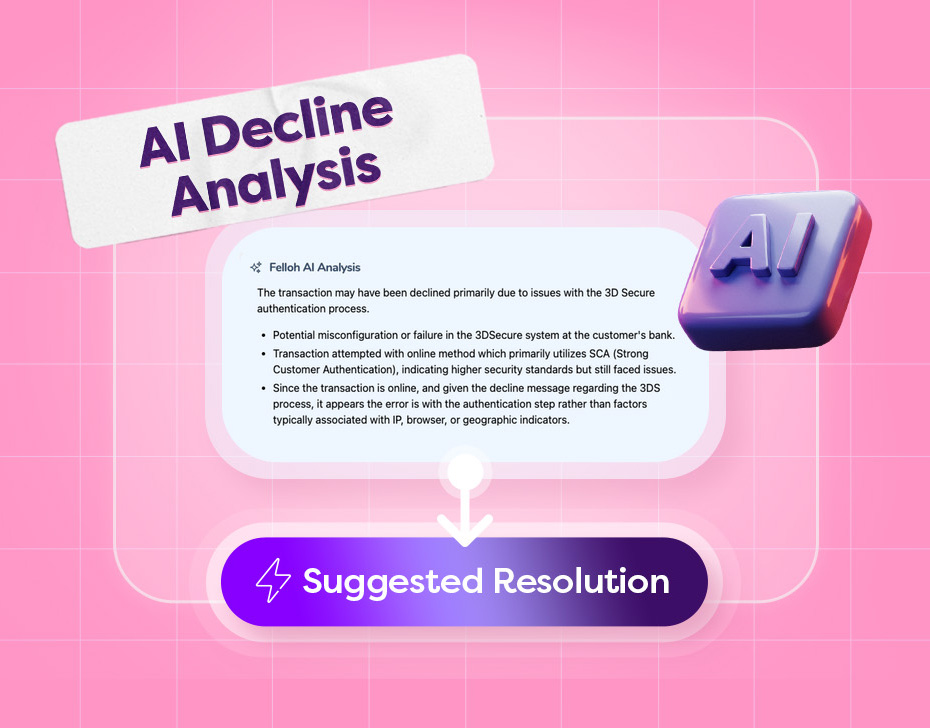
Enhance Your Payment Success with felloh's AI Decline Analysis for the Travel Industry
felloh's AI Decline Analysis surfaces real-time insight on why card payments fail and the best next step — for higher acceptance on travel bookings.
Read article Insights
Minimising Payment Risks of phone payments: The Smart Way for Travel Merchants
Phone bookings are still essential in travel, but they carry payment-security risk. How to keep last-minute trips moving without exposing the business.
Read article
Connect the dots.
See how payments, settlement, refunds and reporting evidence connect around every booking.