Heading to WTM London? Come find us at stand S3-116. We’ve more than good coffee brewing. Pre-book a chat now!

Blog

The latest news, thoughts and insights from our experts in travel payments

Updates

When Fraud Prevention Becomes a Growth Problem

When Fraud Prevention Becomes a Growth Problem

Author Name

CEO / Company

Lorem ipsum dolor sit amet, consectetur adipiscing elit. Suspendisse tincidunt sagittis eros.

Author Name

CEO / Company

Lorem Ipsum is simply dummy text of the printing and typesetting industry.

Profile name

CEO / Creative IT

Lorem Ipsum is simply dummy text of the printing and typesetting industry.

Profile name

CEO / Creative IT

Case Study: How Pura Aventura secured ABTOT-ready compliance data – in under an hour

Author Name

CEO / Company

Lorem ipsum dolor sit amet, consectetur adipiscing elit. Suspendisse tincidunt sagittis eros.

Author Name

CEO / Company

Lorem Ipsum is simply dummy text of the printing and typesetting industry.

Profile name

CEO / Creative IT

Lorem Ipsum is simply dummy text of the printing and typesetting industry.

Profile name

CEO / Creative IT

How Payment Pricing Really Works in Travel: What Headline Rates Don’t Tell You

Author Name

CEO / Company

Lorem ipsum dolor sit amet, consectetur adipiscing elit. Suspendisse tincidunt sagittis eros.

Author Name

CEO / Company

Lorem Ipsum is simply dummy text of the printing and typesetting industry.

Profile name

CEO / Creative IT

Lorem Ipsum is simply dummy text of the printing and typesetting industry.

Profile name

CEO / Creative IT

💩 No Sh*t at WTM London

Author Name

CEO / Company

Lorem ipsum dolor sit amet, consectetur adipiscing elit. Suspendisse tincidunt sagittis eros.

Author Name

CEO / Company

Lorem Ipsum is simply dummy text of the printing and typesetting industry.

Profile name

CEO / Creative IT

Lorem Ipsum is simply dummy text of the printing and typesetting industry.

Profile name

CEO / Creative IT

Categories

Insights

Will AI be an optimiser or disruptor for travel businesses? What it actually means for you.

News

Felloh Shortlisted for Mastercard B2B Payments Award at Travolution Awards 2024

Updates

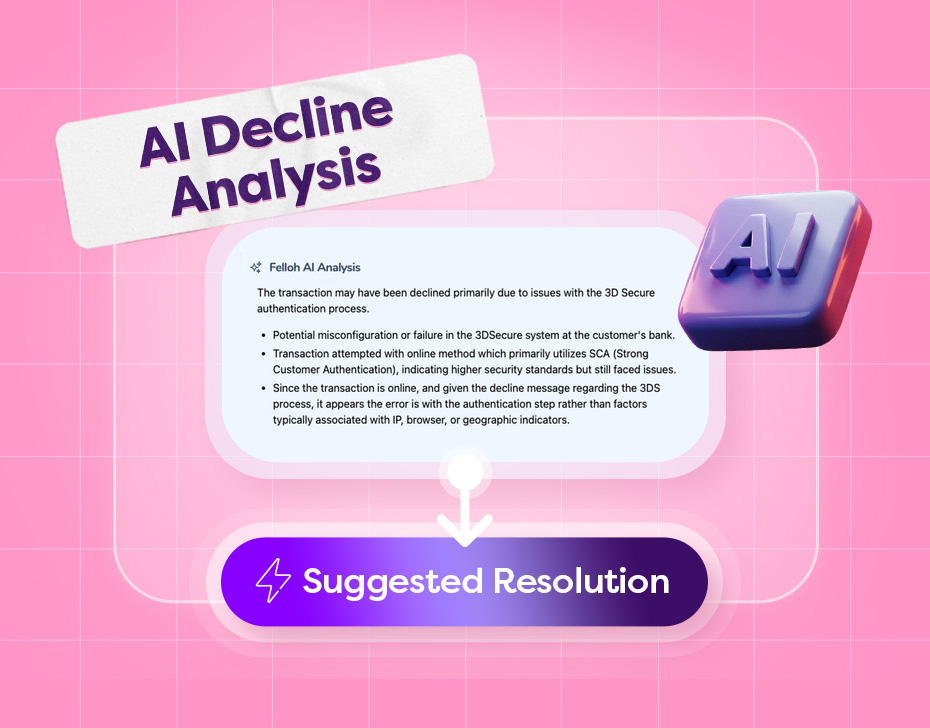
Enhance Your Payment Success with Felloh's AI Decline Analysis for the Travel Industry

Insights

How to avoid chargebacks in travel payments

Insights

From transaction to transformation: why connected payments matter in travel

Insights

The Surcharge Myth: How smart surcharging recovers your lost thousands

Insights

Reconciliation: What it is and why your Travel Business needs it

Updates

Celebrating Another Year as an AITO Business Partner

Stories

Case Study: How Pura Aventura secured ABTOT-ready compliance data – in under an hour

Insights

How Payment Pricing Really Works in Travel: What Headline Rates Don’t Tell You

News

💩 No Sh*t at WTM London

Insights

From transaction to transformation: why connected payments matter in travel

Insights

Travel takes time, travel payments shouldn’t

Insights

New low carbon website

Insights

Travel by B Corp research

Insights

Credit cards and other payments for travel companies

NEWS & RESOURCES

Get free resources

We love sharing our travel expertise, so we're always creating new resources to help travel businesses succeed.

card-other

Free guide

Everything travel businesses need to know about chargebacks

Running a travel business is challenging enough without having to deal with chargebacks eating into your profits and taking up valuable time. This FREE practical guide covers 5 proven strategies on how to avoid them.

See how its works

viloet-up
card-other

Free guide

Everything travel businesses need to know about chargebacks

Running a travel business is challenging enough without having to deal with chargebacks eating into your profits and taking up valuable time. This FREE practical guide covers 5 proven strategies on how to avoid them.

See how its works

viloet-up
card-other

Free guide

Everything travel businesses need to know about chargebacks

Running a travel business is challenging enough without having to deal with chargebacks eating into your profits and taking up valuable time. This FREE practical guide covers 5 proven strategies on how to avoid them.

See how its works

viloet-up
left-pink
right-pink

Get free resources

We love sharing our travel expertise, so we're always creating new resources to help travel businesses succeed.

Free guide

Everything travel businesses need to know about chargebacks

Running a travel business is challenging enough without having to deal with chargebacks eating into your profits and taking up valuable time. This FREE practical guide covers 5 proven strategies on how to avoid them.

arrow-purple

Free guide

Everything travel businesses need to know about chargebacks

Running a travel business is challenging enough without having to deal with chargebacks eating into your profits and taking up valuable time. This FREE practical guide covers 5 proven strategies on how to avoid them.

arrow-purple

Free guide

Everything travel businesses need to know about chargebacks

Running a travel business is challenging enough without having to deal with chargebacks eating into your profits and taking up valuable time. This FREE practical guide covers 5 proven strategies on how to avoid them.

arrow-purple
arrow-left
arrow-right
Thank you! Your submission has been received!
Oops! Something went wrong while submitting the form.

Updates

Adam Clarke

When Fraud Prevention Becomes a Growth Problem

What to do next?

  • 1

    Automate your manual tasks with AI-powered Software as a Service

    You don’t need in-house AI tools to do this, most software providers will be doing the heavy lifting for you

  • 2

    Step up your SEO and AI Optimisation (AIO) strategy

    Make sure your experiences are easily discoverable in consumer-generated itineraries. If you’ve invested in search engine optimisation (SEO) in the past, a lot of that work will be paying off now, but if not, it’s never too late to tag your images, set meta descriptions and make sure your most important content is machine readable.

  • 3

    Experiment cautiously with customer facing AI tools

    If you’re not yet using any AI in your business, now is not the time to rip out your search function on your website and replace it with an AI chat bot! As an end consumer you probably know how frustrating it can be to deal with a poorly trained bot. Instead, find a problem you have which is worth solving but not business critical to start learning in a low-risk environment.

When Fraud Prevention Becomes a Growth Problem

When Fraud Prevention Becomes a Growth Problem

Updates

Adam Clarke

For years, fraud prevention in payments has been treated as a technical safeguard. Add 3DS, rely on a risk score, block a few countries, and move on.

That model no longer reflects reality.

Fraud today is automated, distributed, and deliberately adaptive. Which means fraud controls need to be adaptive too, capable of evolving as patterns change, rather than locking businesses into static defences that age quickly.

For travel businesses, the impact is sharper than in most sectors.

High-value transactions, delayed fulfilment, complex booking journeys, and a mix of online, agent-assisted, and MOTO payments create a risk profile that generic fraud tools were never designed to handle. Yet many travel merchants are still relying on exactly those tools.

The result is a familiar trade-off: tighten controls and damage conversion, or loosen them and absorb the risk.

The Hidden Cost of Generic Fraud Controls

Most fraud systems take a blunt approach. Either they rely on opaque third-party scores that block transactions without explanation, or they enforce rigid rules that apply equally across all customers, markets, and booking types.

In travel, this quickly becomes counterproductive.

A legitimate traveller booking a complex, cross-border itinerary can look risky on paper. At the same time, a coordinated card-testing attack can pass unnoticed if it stays just below static thresholds.

When fraud controls lack context, they stop being protective and start becoming obstructive. Conversion drops, customer experience suffers, and operations teams spend increasing amounts of time reviewing edge cases that should never have been flagged in the first place.

At that point, fraud prevention stops being a security function and becomes a growth problem.

From Static Rules to Connected Risk Signals

The underlying issue is not that travel businesses need more fraud rules. It is that they need better signals, connected together, and the ability to decide how those signals should be used.

Modern fraud is behavioural. It reveals itself through patterns over time, through inconsistencies between customer, card, device, and location, and through the misuse of mechanisms like 3DS rather than simple card theft.

Addressing that requires a connected, layered approach to risk, where signals across the payment lifecycle are assessed together, not in isolation. It also requires acknowledging a reality many fraud tools ignore: not every travel business has the same risk profile, booking model, or tolerance for friction.

What is acceptable risk for a multi-destination tour operator is very different from that of a single-market accommodation provider. Static defaults fail both.

This is the thinking behind Fraud Shield, felloh’s advanced fraud protection layer.

Rather than imposing one-size-fits-all logic, Fraud Shield is designed to give travel merchants granular control over how fraud is assessed and handled, embedded directly within the payments flow rather than operating as a disconnected bolt-on.

Find out more about Fraud Shield

Why Control Is as Important as Detection

One of the most damaging aspects of traditional fraud tooling is not just false positives, but lack of control.

When rules are fixed and decisions are opaque, merchants are forced into a passive position. Transactions fail, customers abandon bookings, and teams are left guessing what changed and why.

In contrast, a configurable approach allows businesses to actively define their own risk posture. Controls can be adjusted by market, booking type, seasonality, or growth stage, reflecting how the business actually operates rather than how a generic model assumes it should.

This is especially critical in travel, where legitimate behaviour often looks unusual and where risk profiles shift constantly based on destination mix, customer geography, and demand cycles.

Treating fraud controls as something that can be tuned and evolved, rather than simply switched on or off, is a clear indicator of whether a payments stack is future-proof.

Rethinking Fraud as Risk Governance

The most important shift is conceptual.

Fraud prevention is no longer just about blocking bad transactions. It is about maintaining operational resilience, protecting conversion, and demonstrating control to acquirers, partners, and regulators.

In other words, it is risk governance, not just fraud blocking.

Static defences are increasingly outpaced by adaptive threats. Travel businesses that continue to treat fraud as a background technical setting will find themselves paying for it in lost revenue, customer frustration, and operational drag.

Those that recognise fraud as a dynamic system, and design their payments infrastructure accordingly, are far better positioned to scale with confidence.


Travel pros also love...

Share via Email Share on Twitter
Thank you! Your submission has been received!
Oops! Something went wrong while submitting the form.