
A refund reverses some or all of a previous payment back to the customer’s original payment method or another agreed return route. It can be a full refund, a partial refund, a credit to a future booking, or a refund against a different funding source where the original is no longer usable. Each refund needs an audit trail showing the decision, the approval and the movement.
Travel payments glossary
Refund
Money returned to the customer after a payment has been taken.
Why it matters in travel
Travel refunds are operationally heavy because supplier payments may already have been made, protection regimes may apply, cancellation terms may limit what is refundable, and the customer expectation may not match the actual policy. Refund decisions made without booking-level context are how disputes start.
A refund in travel is rarely just a reversal — it is a decision about supplier exposure, protection treatment and customer relationship at the same time. A refund issued before the supplier has been billed is straightforward; one issued after is a recovery problem that may not resolve cleanly. Without booking-level context, the decision is made on a phone call and revisited in the dispute team three months later.
The travel businesses that handle refunds well have the supplier, protection and policy context attached to the booking, so the decision is consistent regardless of which agent the customer reaches. The businesses that handle them badly have inconsistent answers, recovery problems with suppliers, and a chargeback rate that surprises them.
How felloh helps
felloh keeps refund requests, approval evidence, payment history and booking context connected for clearer financial control, so refund decisions are made on the same picture finance, operations and customer support are looking at.
The Refunds view in the dashboard enforces a two-stage authorisation flow — initiation by one user, approval by another — with the underlying booking, supplier-payment status and policy context surfaced inline. Audit captures who initiated and who approved, and the Transactions view ties the refund back to the original payment.
For travel businesses where refund decisions used to depend on which agent picked up the call, the policy now applies consistently. The same evidence supports the customer-support answer, the finance reconciliation and the dispute defence months later if a chargeback follows.
Where this shows up in risk and disputes.
Refund touches more than one workflow at felloh. Start with the pages most travel teams reach for next.
- Financial Control
Control refunds, exceptions, supplier exposure and payment risk against the same booking record.
Explore - Financial Protection Data
Authentication, settlement, protected funds and refund history kept with the booking for dispute defence.
Explore - Payment Optimisation
Acceptance, decline and authentication evidence so you can act on the patterns that matter.
Explore
More on payment risk and disputes.
Real-world context from the felloh team and customers, written for travel finance and operations.
 Updates
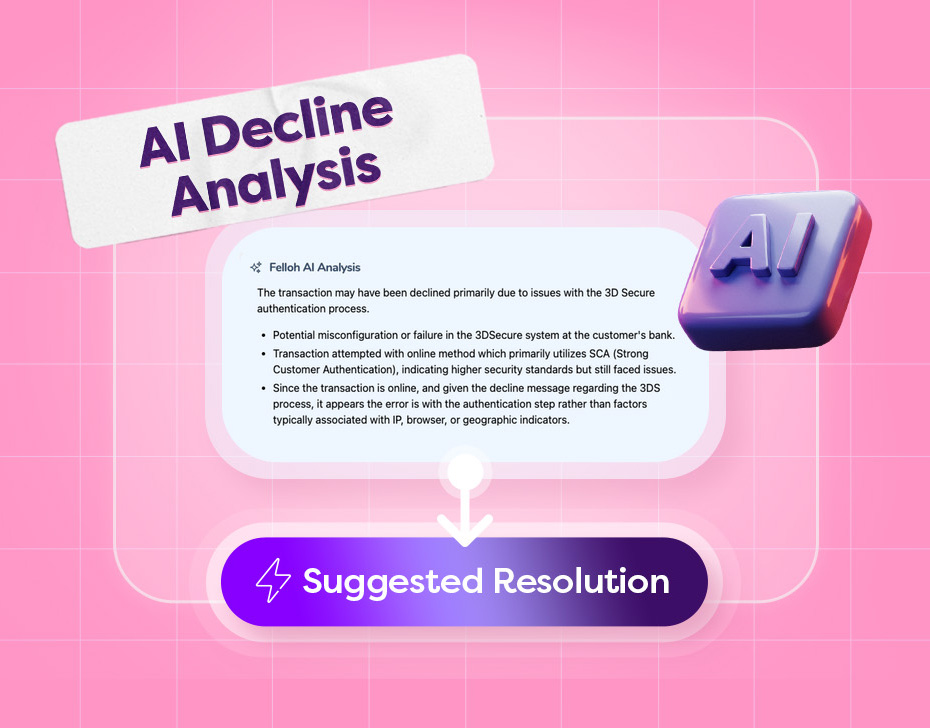
Enhance Your Payment Success with felloh's AI Decline Analysis for the Travel Industry
felloh's AI Decline Analysis surfaces real-time insight on why card payments fail and the best next step — for higher acceptance on travel bookings.
Read article Insights
Minimising Payment Risks of phone payments: The Smart Way for Travel Merchants
Phone bookings are still essential in travel, but they carry payment-security risk. How to keep last-minute trips moving without exposing the business.
Read article
Connect the dots.
See how payments, settlement, refunds and reporting evidence connect around every booking.