The latest news, thoughts and insights from our experts in travel payments
Updates
Giving AI agents access to travel payments: introducing the felloh MCP server
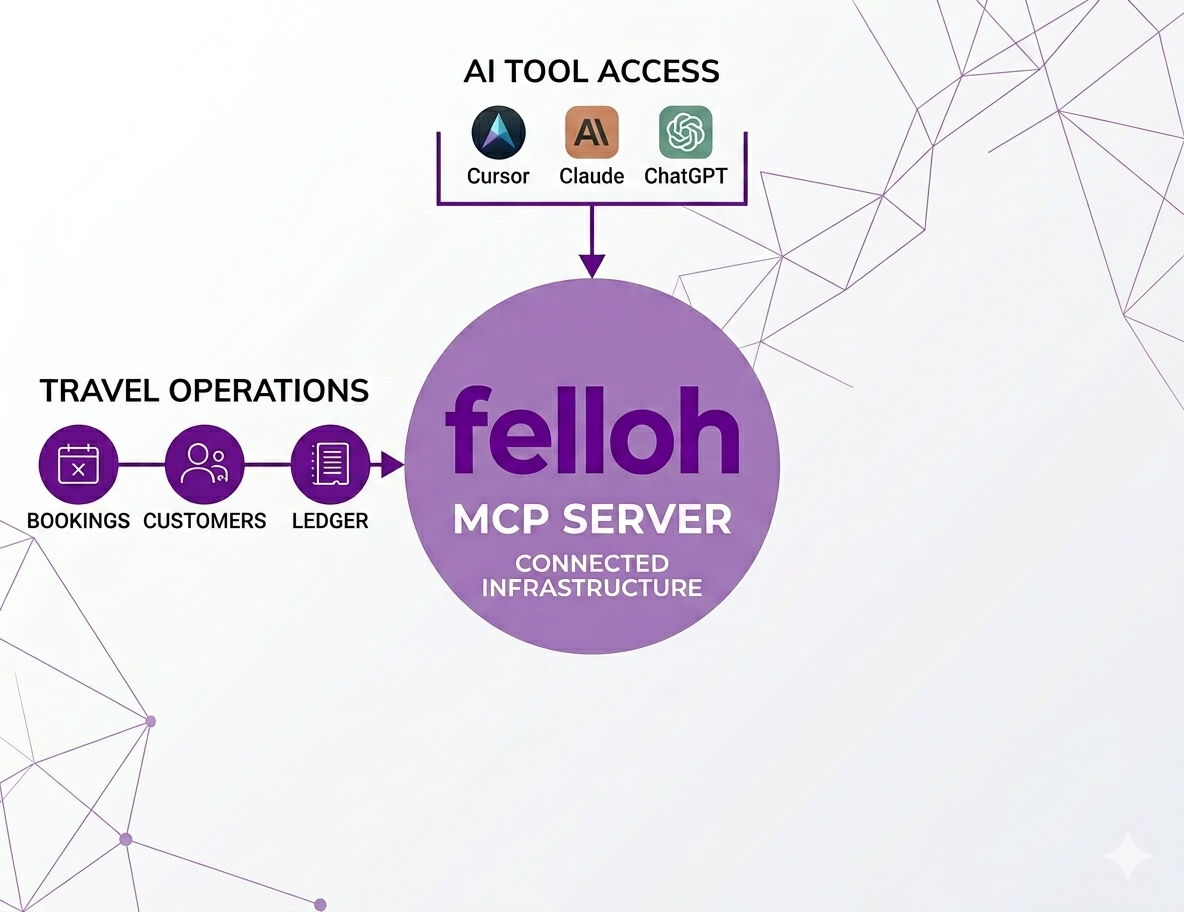
We’ve launched the felloh MCP server to make our connected travel payment infrastructure directly accessible to AI agents through natural language. Rather than manually navigating dashboards or writing custom API "glue," you can now use tools like ChatGPT or Claude to orchestrate complex workflows all while staying grounded in your existing operational controls. This isn’t a separate product, but a new conversational layer that complements our APIs and SDKs, allowing your team to interact with your operational stack in the way that fits you best.
We love sharing our travel expertise, so we're always creating new resources to help travel businesses succeed.
Free guide
Everything travel businesses need to know about chargebacks
Running a travel business is challenging enough without having to deal with chargebacks eating into your profits and taking up valuable time. This FREE practical guide covers 5 proven strategies on how to avoid them.
Everything travel businesses need to know about chargebacks
Running a travel business is challenging enough without having to deal with chargebacks eating into your profits and taking up valuable time. This FREE practical guide covers 5 proven strategies on how to avoid them.
Everything travel businesses need to know about chargebacks
Running a travel business is challenging enough without having to deal with chargebacks eating into your profits and taking up valuable time. This FREE practical guide covers 5 proven strategies on how to avoid them.
We love sharing our travel expertise, so we're always creating new resources to help travel businesses succeed.
Free guide
Everything travel businesses need to know about chargebacks
Running a travel business is challenging enough without having to deal with chargebacks eating into your profits and taking up valuable time. This FREE practical guide covers 5 proven strategies on how to avoid them.
Free guide
Everything travel businesses need to know about chargebacks
Running a travel business is challenging enough without having to deal with chargebacks eating into your profits and taking up valuable time. This FREE practical guide covers 5 proven strategies on how to avoid them.
Free guide
Everything travel businesses need to know about chargebacks
Running a travel business is challenging enough without having to deal with chargebacks eating into your profits and taking up valuable time. This FREE practical guide covers 5 proven strategies on how to avoid them.
Thank you! Your submission has been received!
Oops! Something went wrong while submitting the form.
Insights
Elliot McDonnell
It is important to understand how and why a customer might do a chargeback and what actions you can take as a travel merchant to reduce your chargeback risk. To discuss chargebacks, the history and the main reasons for chargebacks in the travel industry, we must begin with the simple question of what is a chargeback?
How to avoid chargebacks in travel payments
What to do next?
1
Automate your manual tasks with AI-powered Software as a Service
You don’t need in-house AI tools to do this, most software providers will be doing the heavy lifting for you
2
Step up your SEO and AI Optimisation (AIO) strategy
Make sure your experiences are easily discoverable in consumer-generated itineraries. If you’ve invested in search engine optimisation (SEO) in the past, a lot of that work will be paying off now, but if not, it’s never too late to tag your images, set meta descriptions and make sure your most important content is machine readable.
3
Experiment cautiously with customer facing AI tools
If you’re not yet using any AI in your business, now is not the time to rip out your search function on your website and replace it with an AI chat bot! As an end consumer you probably know how frustrating it can be to deal with a poorly trained bot. Instead, find a problem you have which is worth solving but not business critical to start learning in a low-risk environment.
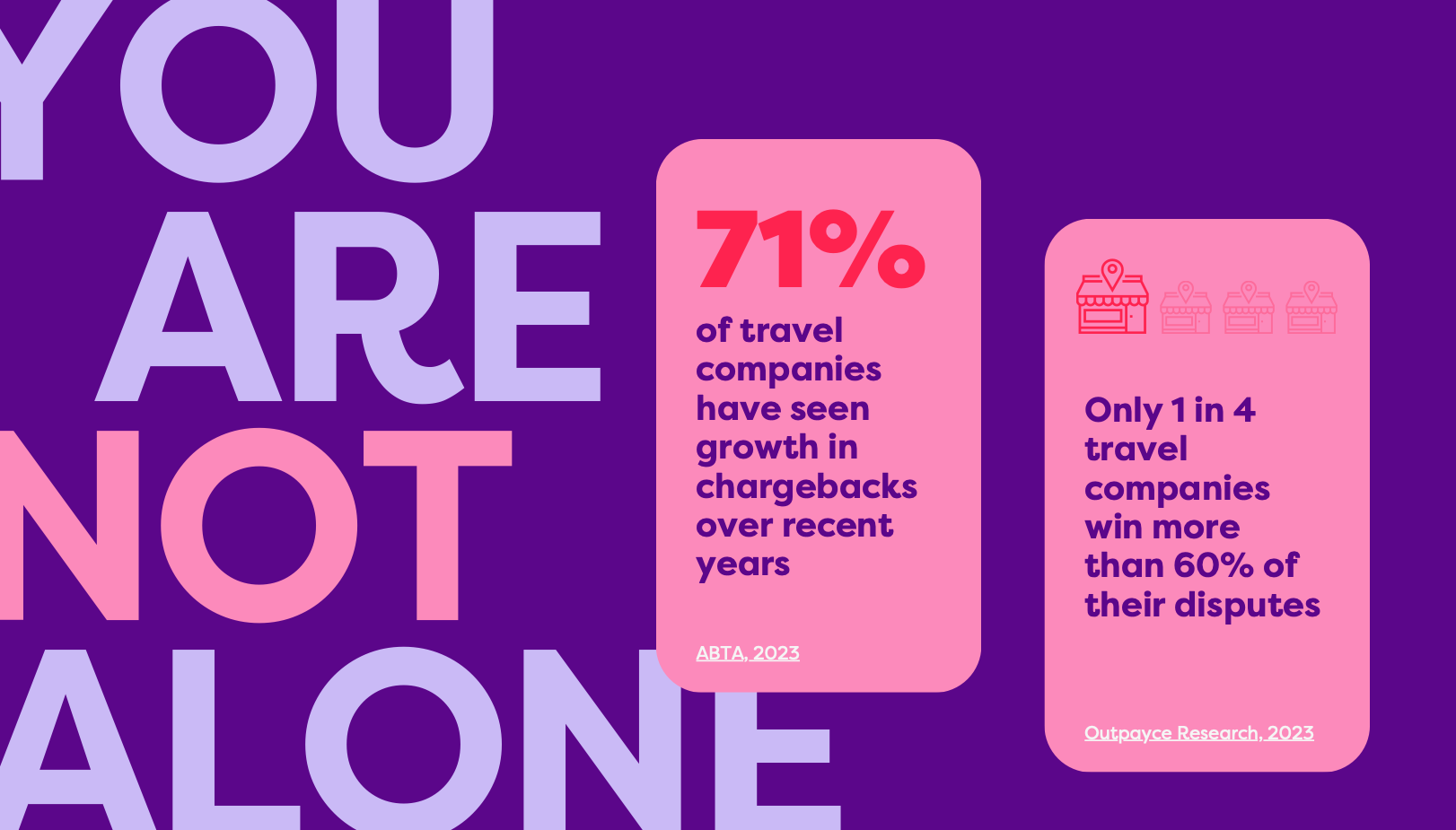
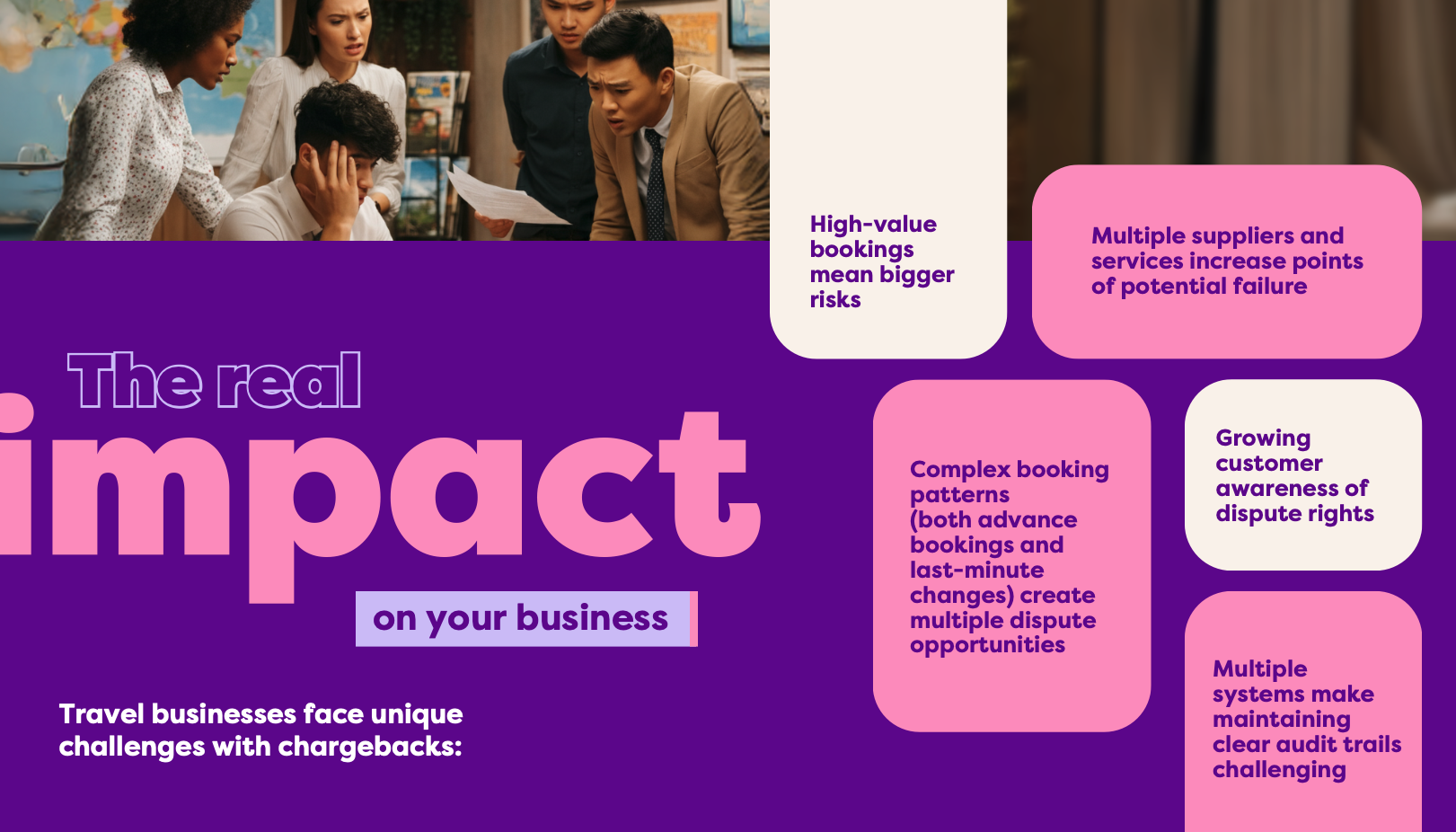
Chargebacks can be a real headache for travel businesses to manage. Particularly post-Covid, consumer awareness of their rights to chargeback has increased and now it is important to understand how and why a customer might do a chargeback and what actions you can take as a travel merchant to reduce your chargeback risk. To discuss chargebacks, the history and the main reasons for chargebacks in the travel industry, we must begin with the simple question of what is a chargeback?
By definition, a chargeback is the return of funds to a cardholder’s (in the most part the end consumer) bank account, credit card or line of credit.
Chargeback claims are initiated by a cardholder with their issuer and from here, a chargeback request, if applicable is raised with a merchant’s acquirer where the merchant is subsequently notified of this chargeback request.
Why were chargebacks introduced and what is the impact on the travel industry and travel merchants?
Chargebacks, first and foremost, were introduced by card issuers as a means of protecting their cardholders and consumers. Chargebacks, unlike Section 75 of the consumer credit act, are not enforced by law, rather it is a standard agreement between the card issuer and cardholder.
Chargebacks are raised, in the most part through 3 main reasons:
1 Merchant Error:
A merchant charges an incorrect amount or charges for a service which is not delivered and or provided as promised.
2 Merchant Fraud:
A cardholder uses their card to pay a fraudulent merchant that has no intention of providing goods or services as advertised.
3 Criminal Fraud:
A cardholder has their card details compromised, allowing a criminal to use their card to process unauthorised transactions.
Commonly, chargebacks are raised in the travel industry mainly relating to points 1 and 3, rarely in relation to the second point.
Avoiding merchant error is within your control, you can reduce the risk of these chargebacks by having simple, tested and repeatable processes when it comes to communicating what a customer is buying and how you process transactions and refunds. Merchant errors are historically the easiest to proactively prevent and protect yourself from as a merchant.
In relation to criminal fraud, there are many approaches one can take to protect themselves from claims being made against them. The single most effective way to protect yourself from processing transactions that are being fraudulently placed by a criminal is to process transactions using pay by link payment forms or ecommerce payment. In the UK and EU, 3DS2 (3 Domain Secure 2) is mandated which shifts the authentication responsibility from the merchant to the 3 domains involved in 3DS2. Those domains are the Issuer (bank of the cardholder), the Acquirer (a merchants payment provider) and the card schemes (Visa, Mastercard etc.) Processing a transaction through 3DS2 means that all three domains must all communicate together to authenticate the transaction.
In contrast to pay by link/3DS2 transactions, a MOTO (which stands for Mail Order/Telephone Order) transaction takes the liability and shifts it to the merchant. Hence in the event of a chargeback, the merchant will have to defend with proof that the person placing the transaction is unequivocally the holder of the card used. In almost all cases, this is nearly impossible to do as a transaction is completed over the phone resulting in the majority of chargeback claims against MOTO transactions to be successful in favour of the cardholder.
The most common example of criminal fraud in travel is when a fraudster will book a short notice trip or flight on stolen card details. You, as the merchant, facilitate their travel (which they will either be purchasing for themselves or on behalf of an unwitting or knowingly fraudulent buyer). Before the cardholder notices the transaction, the travel is complete but the cardholder will issue a chargeback. Your business takes the financial hit of the fraud.
Key things to look out for:
Last minute high value flights
Customer booking on behalf of others (different travel name to cardholder name)
New customers who insist on paying over the phone
Feeling pressured and rushed into the sale - if it doesn’t feel like you’re in control of the call then take a moment to assess if this is a legitimate booking.
What are the implications of chargebacks against a merchant in addition to the potential loss of funds?
In addition to the upfront cost of losing the money paid for a service or good provided by your business, there are other costs and losses to be considered:
Cost of operational time lost.
For each chargeback there are operational losses to be considered as someone on the side of the acquirer will likely have to dedicate time towards defending, managing and accounting for chargebacks.
A merchant must consider the cost of this time lost and the risk they are putting themselves in with the way they process transactions to determine whether or not they are within a sensible risk threshold.
Individual chargeback fee per chargeback.
Each chargeback incurs an additional fee applied by your acquirer to cover their administrative costs related to the chargeback. This fee typically ranges between £15-25 and can exceed £100.
Fines implemented by card schemes and scheme monitoring programmes.
The card schemes can fine merchants who exceed a threshold ratio of chargebacks. This is a ratio of transaction volume rather than total number of transactions. Typically, a fine of £500 is applied by the card schemes when a merchant’s ratio exceeds 10% of transaction value in a given time period (usually 1 calendar month) I.e. if a merchant has a chargeback value of greater than £1,000 in a month where they process only £10,000 of transactions, the fine will be applied. This is particularly impactful on lower transaction volume businesses such as bespoke luxury travel. If you are processing low volume of transactions, the impact of a couple of chargebacks could cost you.
In addition to the above, card schemes may place a merchant on a monitoring programme if the merchant exceeds a set ratio. For example, Visa have a ratio threshold of .65% and Mastercard has a threshold of 1%. These monitoring programmes, if placed on them, can result in a fixed fee being applied to the merchant until their ratio drops below the thresholds of the schemes.
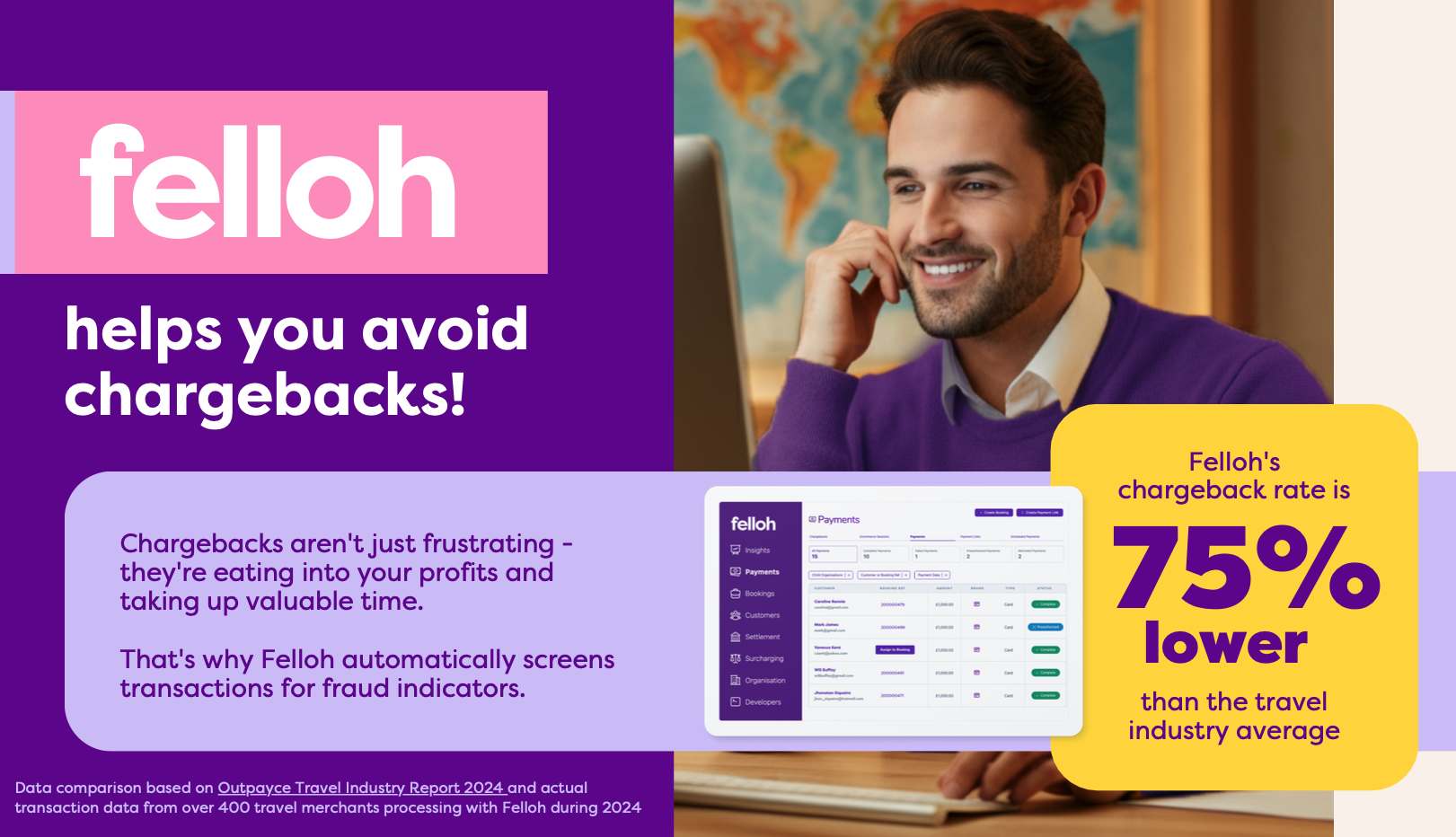
Here at Felloh, our team of payments and travel industry experts design and manage the payments system with your business’ essential needs in mind as well as acting as an intermediary between merchant and acquirer. If you found this article informative and wish to see what other articles we have available, please visit our website. If you would like to learn more about Felloh and where our product can fit into your business to improve operational capability, please get in touch.


.svg)

.png)
.svg)
.svg)




.png)
.png)
.png)
.png)
.svg)


.avif)


.png)


.png)

.png)